
Engineering Story · Golf Cart
From Racetrack Precision to the Fairway
How Yamaha’s performance-engineering mindset helped shape a golf cart that feels composed, quiet, and ready for far more than eighteen holes.

A race motorcycle and a golf cart appear to live in completely different worlds. One chases fractions of a second; the other is expected to move calmly between tee boxes. Yet both reward the same invisible qualities: predictable control, efficient power delivery, disciplined weight management, and mechanical reliability. That shared engineering mindset is one of the most interesting ways to understand the modern Yamaha golf cart.
Inside This Guide
Performance DNA Is Not the Same as Racing Speed
Calling a golf cart “race-bred” should never imply that it was designed for reckless speed. The more meaningful connection is the development culture behind it. In performance engineering, every component must work as part of a complete system.
Steering geometry affects driver confidence. Suspension tuning changes how the chassis settles. Power delivery influences traction, passenger comfort, and energy consumption. Even vibration tells engineers whether a machine feels refined or unfinished.
On a golf course, these principles translate into a vehicle that starts smoothly, tracks predictably, and remains composed across changing terrain. The objective is not drama. It is control so natural that the driver barely notices the engineering working underneath.
The real crossover from the racetrack is not top speed—it is the pursuit of repeatable, confidence-inspiring performance.
Four Engineering Habits That Matter in a Golf Cart
A good golf cart is more than a motor, a battery, and four wheels. Its quality comes from how all those systems work together.
Balanced Handling
Battery placement, passenger position, wheelbase, suspension behavior, and steering effort all contribute to stability.
Controlled Power
Smooth initial acceleration improves passenger comfort, makes low-speed driving easier, and reduces unnecessary tire slip.
Human-Centered Design
Natural pedal placement, supportive seating, useful storage, and good visibility shape every minute behind the wheel.
Repeatable Reliability
Daily charging, changing passenger loads, heat, dust, and moisture test every component of a working golf cart.
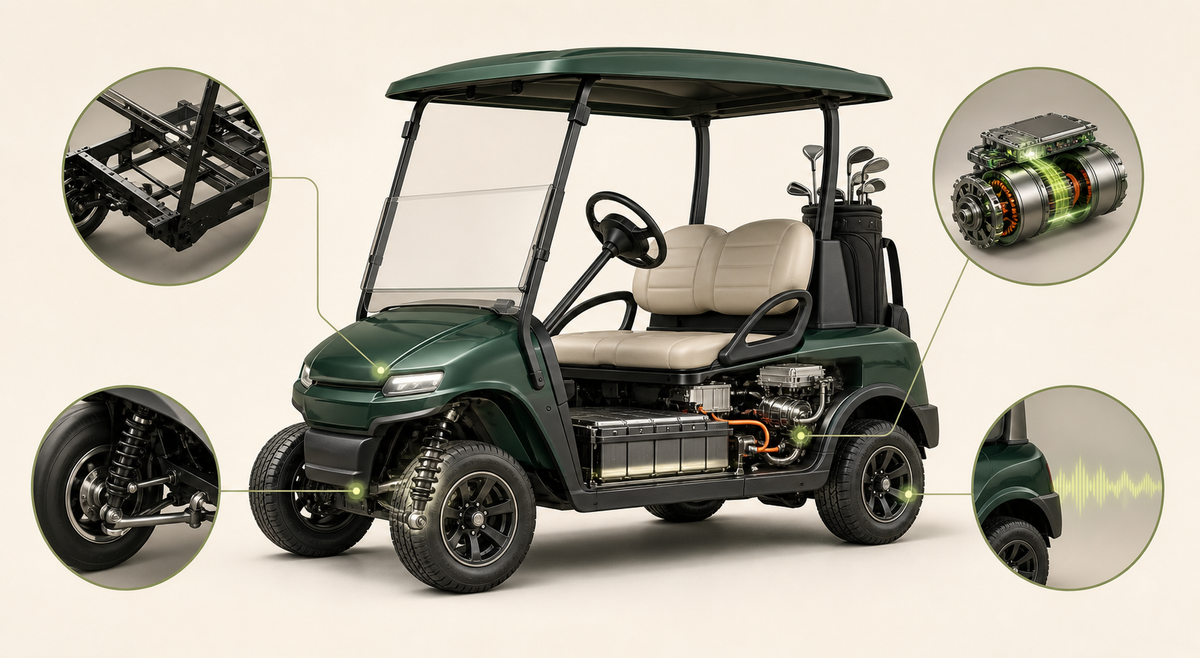
Golf Cart Engineering at a Glance
Individual specifications vary, but these are the qualities that reveal how performance-engineering principles translate into everyday golf cart use.
| Engineering Area | What It Feels Like | Why It Matters | What to Test | Ideal Result |
|---|---|---|---|---|
| Power delivery | Smooth, progressive acceleration | Improves comfort and low-speed control | Start on flat ground and a gentle slope | Predictable response without surging |
| Steering | Natural, consistent effort | Builds confidence on narrow paths | Try tight turns and parking maneuvers | Accurate control without nervousness |
| Suspension | Composed movement over bumps | Supports comfort and stability | Drive across several surface changes | Controlled motion without bouncing |
| Noise control | A calm, refined cabin | Protects conversation and atmosphere | Listen for rattles and vibration | Quiet operation across surfaces |
| Ergonomics | Comfortable, intuitive operation | Reduces fatigue during repeated use | Check seats, pedals and visibility | Controls that feel immediately natural |
Why Quietness Became a Performance Feature
On a golf course, refinement has its own soundtrack—or lack of one. A quiet golf cart respects the atmosphere of the game and makes conversation easier. Electric propulsion naturally helps, but true refinement also depends on controlling rattles, gear noise, tire resonance, and chassis vibration.
This is where a company accustomed to tuning machines can bring a distinctive perspective. Sound is not merely reduced; it is managed. The result is a golf cart that communicates quality through calmness.
Engineering Beyond the Golf Course

Today’s golf cart often works a second job. It may carry guests through a resort, move employees around a campus, serve a private community, or become a personalized neighborhood vehicle. That broader role raises expectations.
Course Manners
Smooth acceleration, quiet operation, predictable steering, and controlled movement across changing terrain.
Everyday Usability
Comfortable seating, practical storage, useful accessories, and a layout designed for repeated trips.
Long-Term Value
Convenient maintenance, accessible service, dependable parts support, and consistent performance.
Flexible Ownership
A platform that can adapt to golf, hospitality, campus transport, property management, or private use.
What Golf Cart Buyers Should Actually Test
Brand heritage is interesting, but the right golf cart should prove itself in person. Use this checklist rather than relying only on a specification sheet.
The Takeaway
Yamaha’s most valuable contribution to the golf cart is not a borrowed racing component or a dramatic speed claim. It is an engineering habit: make every response deliberate, make every system work together, and refine the experience until control feels effortless. On the fairway, that philosophy becomes something wonderfully understated—a golf cart that simply feels right.
Frequently Asked Questions
Does Yamaha use MotoGP technology directly in its golf carts?
The relationship is best understood as shared engineering principles and development experience, not as a claim that a golf cart uses racing components.
What matters most when choosing a Yamaha golf cart?
Match the drivetrain, battery capacity, passenger configuration, accessories, and local service support to your intended use.
Are electric golf carts useful outside golf courses?
Yes. Depending on local regulations and vehicle configuration, they are commonly used in resorts, campuses, private communities, industrial facilities, and large properties.
Ready to Find the Right Golf Cart?
Compare available configurations and choose the golf cart that fits your everyday needs.
Explore Golf Carts